
SEO Content Writing: How to Create Helpful Content That Ranks
I have spent more than ten years writing for blogs, agencies, SaaS companies, and local businesses. In that time I have watched the industry move from keyword stuffing to something much better: writing for people first. If you are learning how to write SEO content, you are starting at a good time. The rules are clearer than ever, even if the work is harder than it looks.
This guide is the one I wish I had when I started. It covers how to create useful, trustworthy SEO content that satisfies readers instead of just pleasing a search engine, and it comes with the habits, checks, and mistakes I have learned along the way.
What Is SEO Content, Really?
SEO content is any page, article, or resource created to attract and satisfy people who find it through a search engine. The goal has two parts: be discoverable, and be genuinely useful once someone arrives. If you only manage the first part, visitors leave. If you only manage the second, nobody finds you.
Many beginners think SEO content means “put the keyword in the title, the first paragraph, and every few sentences.” That approach is outdated. Search engines have become very good at understanding meaning, context, and quality. Google’s public guidance says it wants to reward content that is helpful, reliable, and created for people. So the best SEO content today is simply excellent content that is also easy for search engines to understand.
Think of it as a bridge. On one side is a person with a question. On the other is the answer they need. Your job is to build a sturdy, clear bridge between them, and the technical SEO elements (titles, headings, internal links, structure) are the signposts that help people find it.
Understanding Search Intent Before You Write
The most common reason SEO content fails has nothing to do with writing quality. It is a mismatch between what the reader wanted and what the page delivers. Before I write a single sentence, I study search intent.
The Four Main Types of Search Intent
- Informational: The person wants to learn something (“how to write a meta description”).
- Navigational: The person wants a specific site or page (“Ahrefs blog”).
- Commercial investigation: The person is comparing options (“best SEO tools for small business”).
- Transactional: The person is ready to act or buy (“hire an SEO content writing service”).
Each type needs a different kind of page. If someone searches “SEO content writing service,” they are probably comparing providers, checking prices, or looking for proof of quality. A 3,000-word history of content marketing would not serve them. A page with clear service details, samples, process explanations, and pricing guidance would.
How I Analyze Intent in Practice
Here is the simple process I teach every new writer:
- Search the keyword yourself. Open an incognito window and look at the first page of results.
- Note the content format. Are the top results guides, lists, product pages, videos, or tools? Google is showing you what it believes satisfies the query.
- Read the top three to five pages. Look for what they cover, what they miss, and how they structure their answers.
- Check “People also ask” and related searches. These reveal follow-up questions your reader likely has.
- Write a one-sentence intent statement. For example: “The reader is a beginner who wants practical steps to write articles that rank, without jargon.”
That last step is powerful. A one-sentence intent statement keeps your SEO content focused. When you feel tempted to add a tangent, check it against the statement. If it does not serve that reader, cut it.
Matching Depth to the Reader
Intent also tells you how deep to go. A beginner searching “what is SEO content” needs simple definitions and examples. An experienced marketer searching “SEO content audit framework” needs methodology, templates, and nuance. Writing for the wrong level, too basic or too advanced, is one of the quiet reasons good writers produce content that never ranks.
Creating Useful and Original SEO Content
Search results are crowded with pages that say the same things in slightly different words. If your article is a remix of the top five results, there is little reason for a search engine, or a reader, to prefer it. Originality is how SEO content earns its place.
What “Original” Actually Means
Originality does not mean inventing a brand-new topic. It means adding something that was not already on the page one result. That could be:
- A fresh perspective based on your own work
- Original data, such as a small survey, an internal test, or results from a campaign
- A clearer explanation than anything currently ranking
- A practical template, checklist, or framework readers can use right away
- Real examples and screenshots from actual projects
- Answers to questions competitors ignore
I call this the “information gain” mindset. Before publishing, I ask: What does this article give the reader that they cannot get from the other top results? If I cannot answer, I keep working.
Write to Help, Not to Fill Space
Useful SEO content answers the question quickly and then goes deeper. Put the key answer near the top. Then use the rest of the article to add context, steps, exceptions, and examples. Readers should never have to scroll through three paragraphs of preamble to find out whether the page can help them.
Make It Easy to Read
Even brilliant information fails if it is painful to read. Follow these basics:
- Use short paragraphs, usually two to four sentences.
- Break up long sections with descriptive subheadings.
- Use bullet points and numbered lists where they genuinely help.
- Define jargon the first time you use it.
- Write in a natural, conversational tone, as if explaining to a smart friend.
Good readability is not decoration. It is a core part of SEO content quality because it keeps people engaged and helps them find what they need.
Demonstrating Experience and Expertise in Your SEO Content
Google’s quality guidelines refer to E-E-A-T: Experience, Expertise, Authoritativeness, and Trustworthiness. It is not a single ranking factor you can switch on. It is a framework that helps explain what quality looks like. For anyone producing SEO content, it is a useful checklist.
Show Experience, Don’t Just Claim It
The first “E” is experience, meaning real, first-hand involvement with the topic. Anyone can write “I have tested many SEO tools.” What convinces readers is specifics:
- “When I rewrote a client’s 40 outdated service pages, I noticed that the pages with clear step-by-step explanations were the ones that earned more engagement.”
- “My first article ranked for nothing because I wrote for a keyword, not a person.”
Notice how these statements are concrete and sometimes self-critical. Honest stories about what went wrong build trust faster than polished boasts.
Demonstrate Expertise Through Accuracy and Depth
Expertise shows up in the details: correct terminology, accurate explanations, awareness of exceptions, and the ability to say “it depends, and here is what it depends on.” If you are not an expert in a topic, interview someone who is, quote them properly, and credit them. A good writer does not need to know everything. A good writer knows how to find reliable knowledge and present it clearly.
Build Visible Trust Signals
Trust is the most important part of the framework. Practical ways to strengthen it in your SEO content:
- Add an author bio with relevant background, links to profiles, and a real photo.
- Show editorial standards, such as how you research and review articles.
- Disclose affiliations. If you earn commissions or are reviewing a product you were given, say so.
- Provide clear contact details and an About page.
- Avoid exaggeration. Do not promise “guaranteed first-page rankings.” Nobody can honestly offer that.
For topics that affect people’s health, money, or safety, the bar is higher. Always involve qualified experts and cite authoritative sources.

Research, Evidence, Examples, and Citations
Strong research separates professional SEO content from generic filler. Readers, and search engines, can tell when an article was written from real knowledge and when it was stitched together from other articles.
Build a Repeatable Research Process
My research routine for every article looks like this:
- Start with primary sources. Official documentation, original studies, government or industry reports, and first-hand interviews come before blog summaries.
- Collect secondary sources for context. Reputable industry publications can help, but verify claims against original material.
- Gather real examples. Screenshots, case studies, before-and-after comparisons, and quotes make abstract advice believable.
- Note the date of every source. Outdated statistics can quietly damage your credibility.
- Record sources as you go. Do not wait until the end to hunt for links.
Use Evidence Carefully
Statistics are persuasive, but only when they are accurate and relevant. Never use a number you cannot trace to a reliable source. If you cannot find evidence for a claim, either soften the wording (“many writers find…”) or leave it out. Making up or loosely recalling statistics is one of the fastest ways to lose reader trust.
Cite Without Overwhelming
Citations do not need to make the page look like an academic paper. Link naturally to the original source where it supports a point, and describe what the reader will find there. Cite sparingly but meaningfully. A handful of authoritative references is more helpful than twenty links to loosely related pages. Also remember that you should paraphrase in your own words and quote only short passages, always with credit.
Use Examples to Make Ideas Stick
Examples turn advice into understanding. If I tell a learner “write a strong introduction,” they nod and still do not know what to do. If I show a weak introduction, then a stronger one, and explain what changed, the lesson lands. Strong SEO content teaches by showing.
Content Depth Versus Unnecessary Word Count
One of the biggest myths I hear from beginners is that “longer articles rank better.” Length is not a ranking factor in itself. What matters is whether the page fully satisfies the search. Sometimes that takes 400 words. Sometimes it takes 4,000.
Depth Means Completeness, Not Length
Depth means covering the topic thoroughly enough that the reader does not need to open five more tabs to finish their task. It includes:
- The main answer
- The reasoning behind it
- Practical steps
- Common mistakes
- Relevant examples
- Answers to likely follow-up questions
Padding is the opposite. Padding looks like repeating the same point in new words, long introductions that say nothing, generic definitions nobody asked for, and filler paragraphs added to hit a target word count. Readers sense padding immediately, and they leave.
A Simple Test for Every Paragraph
For each section of your SEO content, ask:
- Does this answer a question the reader actually has?
- Would the article be worse if I deleted this?
- Am I saying something new here, or repeating myself?
If a paragraph fails these tests, cut it. I have often improved articles by removing 20 percent of the draft.
When Long-Form Makes Sense
Comprehensive guides like this one work for broad, competitive topics where readers need a full learning path. For narrow questions (“what is a meta description?”), a short, direct answer may serve better. Choose the length your topic and audience demand. A word count target can be a rough guide for scope, but it should never override usefulness.
Using AI Responsibly in SEO Content Creation
AI writing tools are now part of many content workflows, and I use them too, with clear boundaries. Search engines have said that the method of production is not what matters most. What matters is whether the content is helpful and created for people. Using AI to mass-produce pages to manipulate rankings, however, goes against spam policies.
Where AI Can Help
Used well, AI is a capable assistant for SEO content work:
- Brainstorming angles and related questions
- Summarizing long research material (which you then verify)
- Creating outlines to react to and improve
- Suggesting headline variations
- Checking grammar and clarity
- Repurposing finished content into other formats
Where AI Needs Human Oversight
AI cannot replace the things that make content trustworthy. It has no first-hand experience, it can state false information confidently, and it tends to produce generic, interchangeable text. Therefore:
- Fact-check everything. Verify claims, names, dates, and statistics against reliable sources.
- Add your own experience. Insert real examples, opinions, and lessons AI cannot invent.
- Edit for voice. Make the writing sound like a person with a point of view.
- Never publish unreviewed drafts. A human should be accountable for every published page.
- Be transparent where it matters. If AI played a significant role in a context where readers would care, consider disclosing it.
My Rule of Thumb
Use AI to speed up the parts of SEO content creation that do not require judgment, and keep humans in charge of anything requiring accuracy, originality, or trust. If an article could have been generated by anyone typing the same prompt, it will struggle to stand out.
Content Freshness and Updating Old Posts
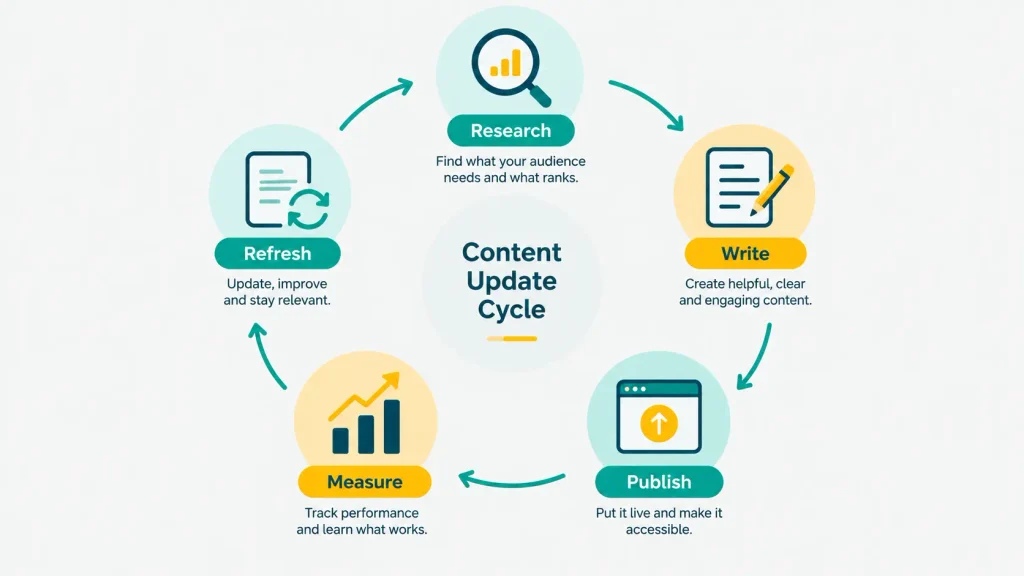
Publishing is not the finish line. Information changes, tools update, laws shift, and examples age. Fresh, accurate SEO content is more helpful, and updating existing pages is often more efficient than writing new ones.
Which Posts Deserve Updates
Not every old article needs attention. Prioritize pages that:
- Used to get traffic but have declined
- Rank on page two or the bottom of page one (small improvements can create big gains)
- Contain outdated statistics, screenshots, or advice
- Target topics where search intent has shifted
- Already attract links or conversions
How to Refresh an Article Properly
- Re-check search intent. Search the keyword again. The results may now favor a different format or angle.
- Review accuracy. Replace dead links, outdated numbers, and obsolete recommendations.
- Fill content gaps. Add sections for questions competitors now answer and you do not.
- Improve structure and readability. Tighten long paragraphs, add subheadings, and refine the introduction.
- Update visuals. Swap outdated screenshots and add helpful images or diagrams.
- Strengthen internal links to and from related pages.
- Update the modified date honestly. Only change it when you make meaningful improvements, not a cosmetic tweak.
Avoid the temptation to “refresh” a page by changing a few words and republishing. That helps no one, and it undermines the trust you are trying to build with your SEO content.
Build Updating into Your Workflow
I recommend a quarterly or biannual content audit. List your top pages, flag the ones that need review, and schedule the work. Treat your site as a living library, not a pile of posts.
Measuring SEO Content Quality and Performance
If you do not measure results, you cannot improve. But measuring SEO content well means looking beyond rankings alone.
Core Metrics to Track
- Impressions and clicks (Google Search Console): Are people seeing and choosing your page?
- Average position and queries: Which searches bring visitors, and are they the ones you intended?
- Click-through rate: A weak CTR may point to a title or meta description that needs work.
- Engagement (Google Analytics): Look at engaged sessions, time on page, and scroll depth for signs that readers find the content valuable.
- Conversions: Newsletter signups, inquiries, purchases, or downloads show whether the content serves business goals.
- Backlinks and mentions: Natural links suggest other people consider your content worth referencing.
Look for Patterns, Not Single Numbers
A single metric rarely tells the whole story. High traffic with no conversions may mean the content attracts the wrong audience. A low bounce rate may simply mean the page loaded and the reader found the answer instantly, which is fine. Always interpret numbers in light of the page’s purpose and intent.
Qualitative Signals Matter Too
Numbers do not capture everything. Read comments, emails, and social replies. Ask customers what they searched before finding you. Watch session recordings if you have the tools. These signals reveal whether your SEO content is solving real problems.
Create a Feedback Loop
Treat each published article as an experiment:
- Publish with a clear goal and target query.
- Review performance after a few months (SEO takes time).
- Identify what is working or failing.
- Improve the page or apply the lessons to future articles.
Over time, this loop is what turns an average writer into a skilled SEO content writer.
On-Page Basics Every SEO Content Writer Should Know
Great writing still needs solid structure so search engines can understand it. Keep these fundamentals in place:
- Title tag: Include the focus keyword naturally, keep it clear and compelling, and aim for a length that avoids truncation.
- Headings: Use one H1 and logical H2 and H3 headings. Include relevant keywords in a few headings, but only where it reads naturally.
- Introduction: Mention the topic early and tell readers what they will gain.
- Keyword usage: Use the focus keyword and natural variations where they fit. Never force them.
- Internal links: Connect related articles so readers and crawlers can navigate easily.
- Image optimization: Use descriptive file names, helpful alt text, and compressed files.
- Meta description: Write a concise summary that encourages clicks.
- Mobile experience: Check that the page is readable and fast on phones.
These basics will not rescue weak content, but they help strong SEO content get the visibility it deserves.
When to Consider an SEO Content Writing Service
Not every business has the time or skills to produce quality articles consistently. That is where an SEO content writing service can help. A good provider researches your audience, studies search intent, writes original and accurate material, and optimizes it properly.
If you are hiring an SEO content writing service, look for:
- Real samples that show depth, clarity, and originality
- A transparent process covering research, editing, and fact-checking
- Subject-matter knowledge or a willingness to interview your experts
- A responsible approach to AI, with human review and accountability
- Honest expectations. Be cautious of anyone promising guaranteed rankings.
Even if you outsource, understanding the principles in this article helps you brief writers better and evaluate the work. And if you are a learner who hopes to offer an SEO content writing service yourself someday, build a portfolio of excellent, well-researched articles first. Quality proof beats big claims every time.
Common SEO Content Mistakes to Avoid
After a decade of editing other writers’ work, I see the same errors again and again:
- Ignoring search intent and writing what you want to say instead of what the reader needs.
- Keyword stuffing, which makes writing awkward and harms trust.
- Copying competitors’ structure without adding anything new.
- Publishing unverified facts, especially from AI tools.
- Padding for word count instead of improving substance.
- Neglecting old content and letting accuracy decay.
- Skipping the edit. Great drafts become great articles through revision.
- Chasing rankings only and forgetting the reader’s actual goal.
Avoid these, and your SEO content will already be ahead of much of what is published.
Final Thoughts: Write for People, Structure for Search
The core lesson of my ten years in this field is simple. The best SEO content is not a trick. It is useful, honest, well-researched writing that respects the reader’s time and is organized so search engines can understand it.
Start with search intent. Add original value and first-hand experience. Back your claims with credible evidence. Choose depth over padding. Use AI as an assistant, not an author. Keep your pages fresh, and measure what matters. If you do these things consistently, your SEO content will earn trust from readers first, and rankings tend to follow.
Be patient with yourself as a learner. Every professional writer once published articles that went nowhere. The difference is that they kept improving, kept listening to readers, and kept treating every piece of SEO content as a chance to be genuinely helpful.